Turkish stylometry walkthrough
A complete runnable example: attribute a small Turkish short-story corpus using MFW + Ateşman readability + Burrows Delta. The stories are public-domain Ömer Seyfettin texts from Turkish Wikisource.
Setup
uv pip install 'bitig[turkish]'
python -c "import stanza; stanza.download('tr')"
bitig init seyfettin --language tr
cd seyfettin
This scaffolds a project directory with study.yaml pre-configured for Turkish. Confirm
with:
The language row shows tr.
Corpus
Place 3-5 Turkish short stories in corpus/ as UTF-8 .txt files. A good public-domain
source is Ömer Seyfettin on Turkish
Wikisource — dozens of early-20th-
century short stories are already transcribed there.
Add a corpus/metadata.tsv:
filename    author  year
bomba.txt   Omer_Seyfettin  1910
kesik_biyik.txt Omer_Seyfettin  1911
forsa.txt   Omer_Seyfettin  1913
pembe_incili_kaftan.txt Omer_Seyfettin  1917
A real study would include several authors. For a single-author demo, pair Seyfettin with a few stories by Refik Halit Karay (also public domain) to give Delta something to discriminate.
Running the study
bitig ingest corpus/ --language tr --metadata corpus/metadata.tsv
bitig run study.yaml --name first-run
bitig ingest runs Stanza through spacy-stanza. The first run parses every document and
caches the DocBins; subsequent runs hit the cache and finish in seconds.
What you get
A default Turkish study computes:
- MFW (top 1000 tokens, z-scored relative frequencies)
- Turkish function words — loaded from
resources/languages/tr/function_words.txt, derived from UD Turkish BOUN closed-class tokens - Ateşman and Bezirci-Yılmaz readability indices
- Burrows Delta + PCA/MDS reduction plots
The output folder results/first-run/ contains:
result.jsonwith Delta scores and provenancetable_*.parquetfeature matrices- PNG / PDF figures (distance heatmap, PCA scatter)
- a
provenance.jsonthat records the corpus hash, seed, and full resolved config
Worked example: 28 short stories by Ömer Seyfettin
The examples/turkish_seyfettin/ directory in the repository ships a complete,
end-to-end run against 28 short stories by Ömer Seyfettin (1884-1920; in the
Turkish public domain since 1991), scraped from
tr.wikisource.org by fetch_corpus.py and committed
alongside the study so the numbers below are reproducible to the exact random
draw.
python examples/turkish_seyfettin/fetch_corpus.py --n 30   # ~30s, polite to Wikisource
python -m bitig run examples/turkish_seyfettin/study.yaml --name seyfettin
Corpus. 28 stories survive the >200-token cutoff; story lengths range from
326 to 4 455 tokens (median ≈ 1 700). Wikisource transcriptions are CC BY-SA 4.0;
attribution and source URLs live in examples/turkish_seyfettin/manifest.json.
Study. Five hundred most frequent words (z-scored, min_df = 2) +
Turkish function-word frequencies → Burrows Delta self-attribution + PCA + Ward
hierarchical clustering. Single-author setups don't admit between-author
verification (Imposters / classify), so this is exploratory within-author
stylometry, not authorship attribution.
Burrows Delta self-attribution
Across the 28-story leave-one-out grid, every story's nearest training neighbour
is itself (accuracy = 1.0). For a single-author corpus that's the trivial result
— every document is closer to its own MFW profile than to any other — but it
also confirms that no story has been mistakenly tagged with a different author's
metadata. The interesting signal lives one rank deeper, in the rank-2 nearest
neighbour, which surfaces stylistically adjacent stories. The pairwise distance
matrix used for ranking is preserved in
results/seyfettin/burrows/result.json.
PCA on the MFW-500 lexical space
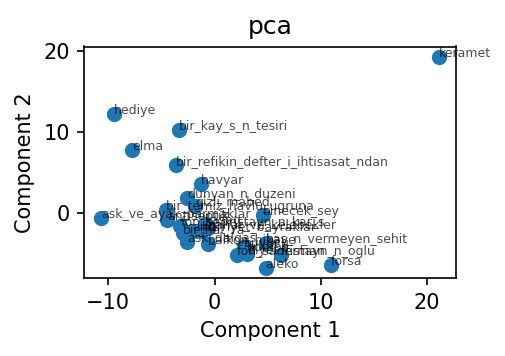
PC1 explains 7.7 % of the variance, PC2 explains 7.2 %. That no single component dominates is itself diagnostic: lexical variance inside one author is spread across many small axes rather than concentrated in one or two. Compare this to a between-author PCA (e.g. the Federalist tutorial) where PC1 alone routinely captures 30 %+.
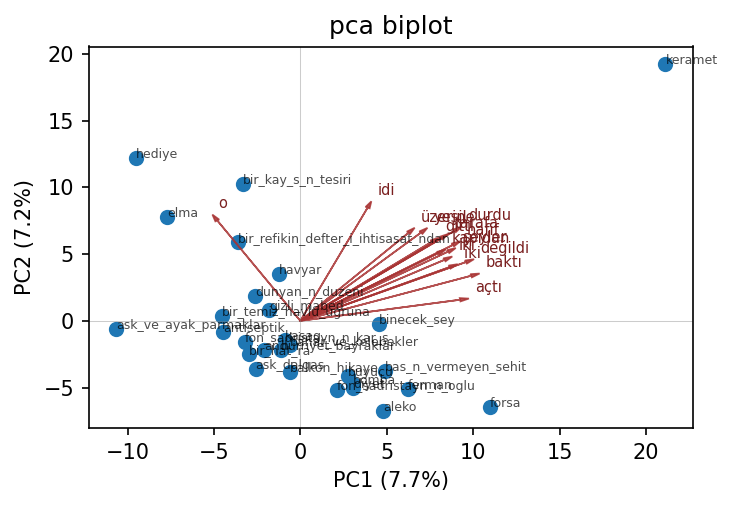
Top loadings — PC1: baktı, değildi, açtı, durdu, hafif, iki, şeyler, gelince.
PC1 separates stories that lean on simple-past 3rd-person narration verbs
(baktı, açtı, durdu) from those without.
Top loadings — PC2: idi, ediyordu, onu, o, olduğu, nihayet, etti, durdu.
PC2 picks up the past-imperfective auxiliary (idi, ediyordu) and the
3rd-person pronoun cluster (onu, o, olduğu) — i.e., the choice between
extended-state description and event-driven narration.
The biplot overlays the top-12 loading vectors onto the same 2-D projection:
Open the interactive plotly biplot ↗ — hover to read story IDs and arrowhead labels.
Ward hierarchical clustering (k = 4)
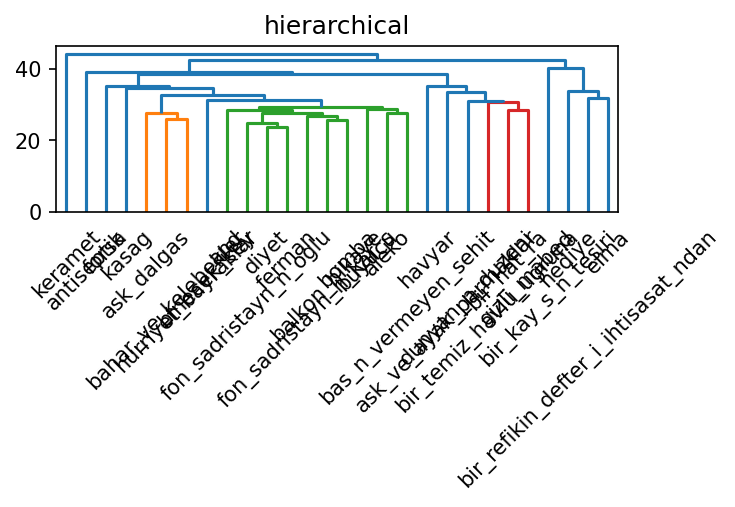
Cutting at four flat clusters yields:
| Cluster | n | Member story IDs |
|---|---|---|
| 0 | 23 | the bulk of the corpus (aleko, bomba, kasag, forsa, …) |
| 1 | 3 | bir_refikin_defter_i_ihtisasat_ndan, elma, hediye |
| 2 | 1 | bir_kay_s_n_tesiri |
| 3 | 1 | keramet |
The three-story cluster turns out to be the three shortest pieces in the corpus (329 / 517 / 457 tokens). The two singletons are also short (554 and 511 tokens). What the dendrogram is mostly surfacing, in other words, is a length-driven signal: z-scored MFW counts get noisy below ~600 tokens, so short stories drift away from the main cloud regardless of topic. This is not a bug in the method — it is the natural consequence of MFW estimation variance at small N, and it is the single most useful thing this analysis tells you:
Open the interactive plotly dendrogram ↗
If you are running stylometry on Turkish short prose, raise the per-document token floor to at least 1 000 — or move to character n-grams, which are far more length-tolerant — before drawing topic / period conclusions from the sub-cluster structure.
Caveats and what is not shown here
A genuine authorship-attribution demonstration needs at least one additional PD-old Turkish prose author with comparable Wikisource coverage, which Wikisource:tr does not currently have for the early-republican period (Refik Halit Karay's transcriptions are present but the underlying texts will not enter the Turkish public domain until 2036). For attribution work we recommend pairing Seyfettin with a different-genre control corpus (e.g. parliamentary speeches, Türkçe Wikipedia featured articles by topic, or your own institutional corpus) rather than a contemporaneous literary author.
Customising
Edit study.yaml to swap features or methods. For example, to use contextual embeddings
instead of MFW:
features:
  - id: bert_tr
    type: contextual_embedding
    # model auto-resolves to `dbmdz/bert-base-turkish-cased` via the language registry
    pool: mean
For a heavier Turkish encoder, point model: at any HuggingFace checkpoint:
Notes on Turkish specifics
- Morphology. Turkish is agglutinative; a token like
evlerinizdenpacksev+ler+iniz+deninto one form. Stanza's Turkish BOUN model lemmatises and tags these correctly, which matters for POS-ngram and dependency-based features. - Syllable counting. Both Ateşman and Bezirci-Yılmaz count syllables using a
vowel-counter specialised for Turkish orthography (including
ı,ğ,ş,ç,ü,ö). - Function words. The bundled list leans on Turkish's closed-class postpositions,
conjunctions, and discourse particles (e.g.
ile,ancak,fakat,çünkü,ki,ise).
Troubleshooting
ModuleNotFoundError: No module named 'spacy_stanza'— runuv pip install 'bitig[turkish]'.FileNotFoundError: ... stanza_resources/tr/default.zip— runpython -c "import stanza; stanza.download('tr')". The model is about 600 MB.- Very slow first ingest on MPS. Stanza's Turkish model does not yet support Apple Silicon MPS. Expect CPU parse rates on first run; subsequent runs are cache hits.